So . . . You Have to Talk to Parents

Updated: Jun 4
If you spend enough time in teacher spaces, you will hear spectacular parent horror stories. The kind involving accusations, bizarre demands, midnight emails, and enough drama to fuel an entire Netflix miniseries.
Those stories exist.
They are not the norm.
One of the biggest mistakes beginning teachers make is assuming every parent interaction is going to be a battle.

Most parents are simply trying to advocate for a child they love, sometimes skillfully, sometimes awkwardly, and sometimes while carrying their own history with schools.
Some teachers speak to parents the same way they speak to twelve-year-olds.
Others suddenly become armchair psychologists, confidently diagnosing issues they are not qualified to diagnose.
Some jump straight to “your child needs special services” conversations without understanding the larger picture.
None of those approaches build trust.
Let's start with some basics:
Contact early
Parents are not the enemy
Speak like a professional adult
Describe behavior, not character
Listen for what is actually being said
Ask parents for strategies
Document important communication
Save the weird stories for later
Contact Early
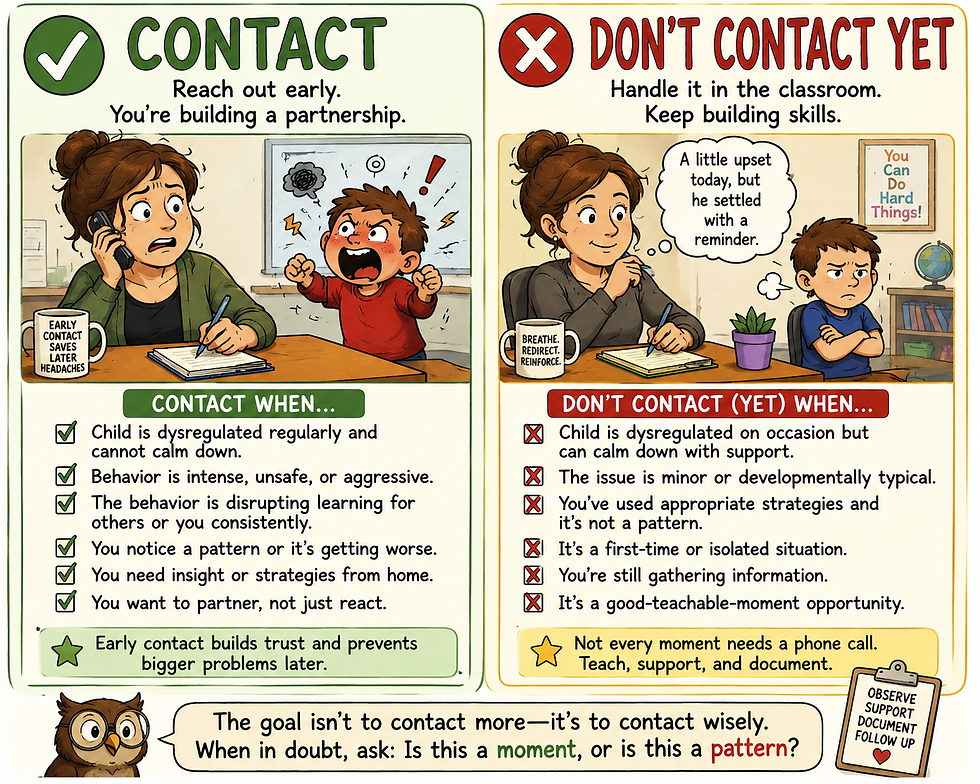

I cannot overstate the importance of early parent contact.
New teachers often hesitate because the issue feels too small, they do not want to bother the parent, or they are afraid the parent will be angry.
That hesitation can create much bigger problems.
If you notice a pattern and the student is either unwilling or unable to stop behaviors that disrupt learning, affect other students, or significantly interfere with the classroom environment, reach out.
Not every issue requires parent contact.
Johnny dropped his pencil, got frustrated, and needed a reminder to calm down? That is classroom management.
Johnny dropped his pencil, accused classmates of stealing it, and when you pointed out that the pencil had rolled off his desk, insisted everyone was gaslighting him? (It was there. Paula watched it roll.)
That is parent contact.
Even if it is the second day of school.
Example Script for a parent phone call
Phone call version:
“Hi, this is __________ from __________ School. Do you have a quick minute to talk about Johnny?
I wanted to let you know about something that happened today and see if you have any helpful insight.
Today, Johnny became upset when he could not locate his pencil. He believed another student had taken it, and even after we located the pencil, he remained convinced that someone had moved it.
I wanted to check in to see whether this type of anxiety or frustration happens in other settings and whether there are strategies that tend to help him reset.”
Now you have established contact, invited the parent to be your partner instead of your enforcer, and opened the door to information you may not have had otherwise.
Because maybe:
child has diagnosed anxiety
parent recently divorced
grandparent died
medication change
terrible prior teacher experience
poor sleep
sensory issues
The key is information, not assuming cause.
If you wait because you hope the behavior will stop on its own—or because you are worried the parent may be upset that you contacted them—you risk allowing someone else to establish the story first.
A month later, the parent calls the office to report that Johnny is being bullied in your class and that repeated concerns have been ignored.
Now you are not starting a conversation.
You are defending yourself in one.
Parents Are Partners, Not Opponents
Sometimes teachers make assumptions.
If a student has poor behavior, we may assume the parent does not care, excuses everything their child does, or simply cannot tell the difference between appropriate and inappropriate behavior.
Yes, those parents exist.
No, they are not the majority.
In fact, they are not even the majority of parents whose children struggle behaviorally.
More often, parents are dealing with the same behaviors at home and simply do not know what to do about them.

At home, the structure is usually looser. A child may not be expected to sit still for long stretches, wait their turn in a room full of peers, or transition rapidly between tasks, and despite what some people seem to think, giving birth did not come with an instruction manual.
Many parents have already tried what they thought would work. It did not help. Now they feel judged, embarrassed, and increasingly convinced that both they and their child are failing.
That is not the mindset of an enemy.
That is the mindset of someone who may desperately need a partner.
When you see difficult behavior, it is important—as I keep repeating—to separate the behavior from your moral evaluation of the behavior.
The same applies when contacting the parent.
Your role is not prosecutor.
Your role is investigator, problem-solver, and collaborator.
You are consulting the parent because you need more information.
Is this behavior happening in multiple settings?
Is it new?
Has something changed?
What has worked before?
What has failed spectacularly?
If you work in a setting where students have multiple teachers, use that.
Data is your friend.
Before making assumptions, ask questions.
I often start with one other teacher.
“Are you seeing this too?”
If they describe the same pattern, I expand the conversation.
“Is this happening across the board, or only in certain settings?”
Because context matters.
I also benefit from teaching 8th grade in a TK–8 school. That means I can sometimes talk to teachers who had the student years earlier.
Those conversations can completely reframe your understanding.
A messy divorce.
The death of a parent.
Years of academic frustration.
Undiagnosed anxiety.
A pattern of being labeled “the bad kid.”
Once you know the backstory, the child often stops looking like a behavior problem and starts looking like a human being having a hard time.
That shift matters.
When you make parent contact, give the parent room to vent.
Sometimes what looks like defensiveness is actually exhaustion.
For example, if you are calling about a high-energy child, the parent may already have years of being told:
“Your child is hyper.”
“Your child needs medication.”
“Your child needs special education.”
“Your child is the problem.”
If that has been their experience, they may come into the conversation guarded.
That does not mean they are unwilling to work with you.
It means trust needs to be built.
So start with something factual and non-threatening.
Instead of: "Your child is constantly disruptive.”
Try:“I’ve noticed a lot of trips to the bathroom and requests to get water. I’m wondering whether this is a newer behavior or something that has been going on for a while.”
That opens a conversation instead of starting a fight.
If the parent explains that previous teachers made them feel judged for refusing medication, suddenly your approach becomes much clearer.
Now your conversation becomes:
“Okay, that helps me understand the bigger picture.”
“Since PE is at the end of the day and he has me right before lunch, I wonder if part of this is a movement need.”
“I have the grass field right outside my room, so I’m thinking of having him drop his belongings and take a quick lap before class starts.”
“Could you help by making sure he has a water bottle so he can refresh without needing to leave class?”
“Let’s try this for a week and touch base again.”
That is problem-solving.
That is partnership.
Another example:
“Hi, this is __________ from __________________.”
“I wanted to check in because I’ve had difficulty getting your child to complete and submit classwork.”
“What I often see is a strong start, but once the assignment becomes more challenging or cannot be finished quickly, they seem to shut down.”
“Does that pattern sound familiar? Is there any background or strategy that might help me better support them?”
Notice what this does:
You are describing a pattern.
Not assigning blame.
Not diagnosing.
Not accusing the parent of failing.
Just gathering information.
And sometimes the conversation is more serious:
“Good afternoon. Let me know if this is not a good time, because today’s situation may take a few minutes to explain.”
“Normally your child and I have a positive relationship, which is part of why I wanted to call.”
“Over the last week, I’ve noticed behavior escalating.”
“On Monday, they repeatedly left their seat despite multiple prompts.”
“Tuesday involved visible frustration and refusal to follow simple directions.”
“Today, when I asked them to wait until instructions were finished before leaving for the bathroom, they responded with ‘Screw that’ and walked out.”
“Is something happening that I may not be aware of?”
“Is there any background information that might help me better understand what’s going on?”
“Would it help to have a meeting where your child can explain what’s upsetting them, with support from you, me, and possibly the counselor?”
That is a very different conversation from:
“Your child has become impossible.”
Parents are not always easy.
Neither are teachers.
Neither are children.
But most parents are not waiting by the phone hoping for a fight.
Most are trying to help a child they love with whatever tools they currently have.
Approach accordingly.




Comments